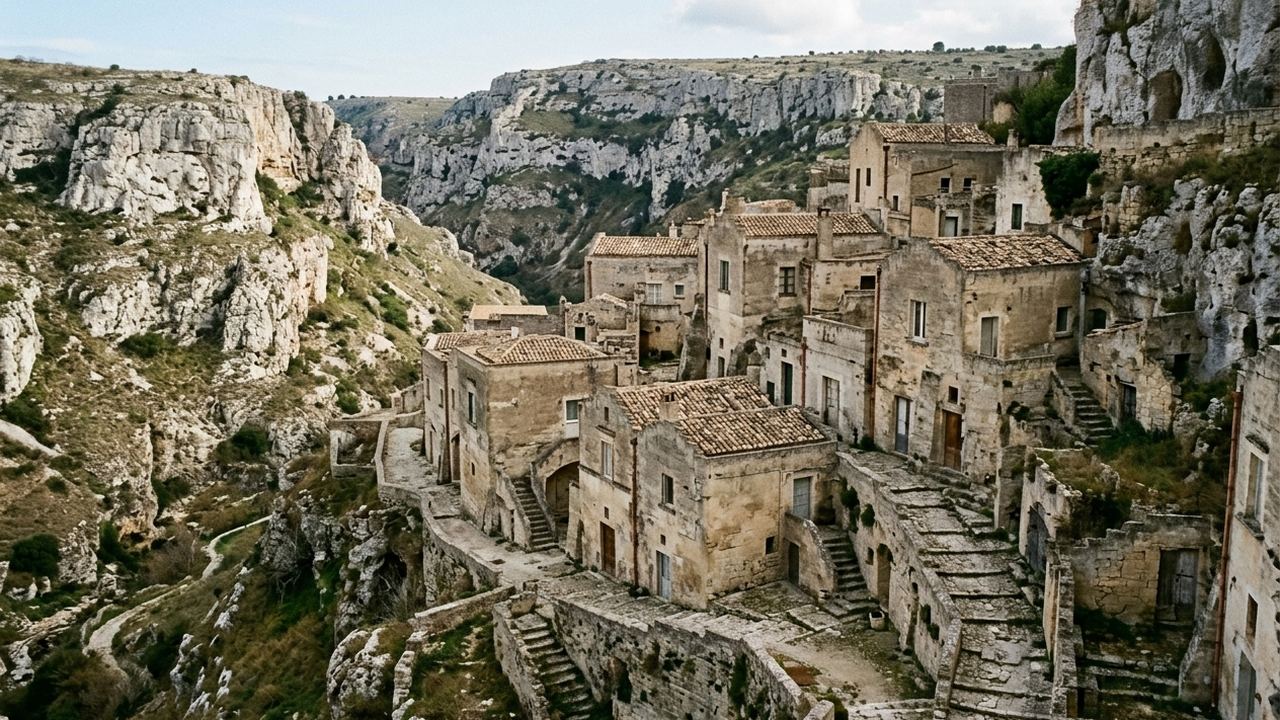
The photographs are all taken from the far side of the ravine, in the twenty minutes when the light does what it does, and they leave out the two facts that decide whether you enjoy the week. The first is that almost nobody lived in those caves for fifty years. Between 1952 and the late 1960s the Italian state emptied them under law, moved some fifteen thousand people up onto the plateau into new blocks, and left the old town standing open and rotting. What you sleep in when you book seven nights in the stone towns of Basilicata is not a dwelling occupied without a break since the Bronze Age. It is a dwelling that was condemned, abandoned, bought back cheap, and rewired, most of it inside the last twenty years.
The second fact is that the place is vertical, and no picture taken from across a gorge can tell you that. Matera is a working provincial city of about sixty thousand people whose ordinary life, the schools and the offices and the supermarket, happens on the flat ground at the top. The photographed part is the bottom. Everything you do in it, you do on steps.
And Basilicata is not only Matera. The region runs to roughly 3,900 square miles of ravine, badland and forest, with sand on the Ionian side about forty five minutes off and cliffs on the other coast two and a half hours away. Once you leave the two lanes where the coaches stop, English effectively stops as well.
- What the week is
- Seven nights in a single cave room in Matera with no repacking, a driver on four of those days who returns you to the same door by evening, and your bags carried up the steps once on the way in and once on the way out.
- What sets it apart
- The airport at Bari is 40 miles off, an hour and ten minutes by road, and it is the practical way in; Naples is three and a half hours west. Matera sits away from the national rail network. The ground is calcarenite, a soft yellow limestone worn hollow underfoot, cut into steps that seldom carry a rail. Beds are in cave rooms: stone walls, one door sized opening, little daylight past the first few feet. The season runs mid March to late November, from $2,390 per person.
- What the figure covers
- Seven nights in a cave room with breakfast; a driver and vehicle on four full days, out and back the same evening; timed entry and a key holder for two rock-cut churches on the far bank, one of them painted in the ninth century; a half day on foot through both lower districts with a Matera guide who works in English; the descent into the gorge and the climb out with a walking guide who carries water for the party; two dinners in the lower town with wine; pickup and return at Bari; and a written sheet of bus departures, closing days and church opening times for the three days nobody is driving you.
- What it leaves to you
- Flights, which run $780 to $1,340 round trip out of the northeast depending on the month; lunches, figure $14 to $22 a head; five of the seven dinners; the single room supplement of $410; entry at Melfi castle and the Metaponto museum, $6 to $10 each; a hire car for the free days at about $52 a day plus fuel near $7 a gallon; tips; and the restricted zone fine of roughly $95 that arrives by mail four months later if you drive into the lower town yourself.
- Who this one is wrong for
- Do not book this if stairs are a problem. The cave room is reached by twenty two steps with luggage and there is no lift anywhere in the lower town. A normal day here is 900 to 1,500 steps of climb and descent on stone that is uneven, sloped and slick until the sun dries it. The walk down into the gorge and back is 4.5 miles with 700 feet of descent and the same climb out, in open sun with no water on the route. No vehicle can drive you in or out of the lower town.
Soft rock, hard steps, and the dead hours in the middle of the day
The stone is calcarenite, soft enough to cut with hand tools, which is the entire reason there is a town here rather than somewhere else. Softness has a cost. Six centuries of feet have worn the steps into shallow bowls that hold water, and the bowls are exactly where you want to put your weight. The lower lanes get hosed down early, so between about seven and nine in the morning a good deal of the town is greasy. Leather soles are the wrong footwear. Bring something with a lugged rubber sole and accept that it looks wrong at dinner.
Heat is the other thing the ground does. In the middle of summer the reading sits between 95 and 104F, the plateau across the gorge carries no shade at all, and the stone gives back its heat until close to midnight, so the lower town does not cool the way the upper town does. Winter is 38 to 50F with real rain, and cave rooms feel colder than the number because the humidity holds near 70 percent. Spring and autumn are the reason to come.
A day here is cut in two and there is no fighting it. Shops and most churches close somewhere around one and reopen at four or half past. The rock-cut churches on the far bank keep short times that change with the season, and several of them open only when a key holder walks out to meet you, which has to be arranged a week or more ahead. So the working shape is this: out early, back in for the dead middle, out again at five, and dinner at half past eight because almost nothing serves before then.
The party that does well on this ground
This week suits people who want one bed for seven nights and no repacking, and who would rather not be the person deciding which of forty rock churches is the one worth the drive. It suits people whose free weeks are fixed and few: seven nights on the ground fits inside a nine day block once the overnight flight and the day you lose to it are counted, and nothing in the plan needs a spare day held back in case something slips. It also suits people whose weeks fall outside the summer, which here is an advantage rather than a compromise, because the two strongest stretches of the year are both outside it.
It does not suit a beach week. The Ionian sand is an hour off and one of the four driving days can go there if you want it, but this is a week about stone, and someone hoping for seven days of swimming will spend most of it disappointed on a staircase.
Six cells, one for each obstacle, filled where this trip answers. Read the words below rather than the strip; the strip is a shorthand.
- The dates are fixed and short
- answers it. Everything else that answers it
- Somebody will not fly, or not far
- does not. Basilicata is a transatlantic flight and then an hour of road, and no rail or sea route out of the United States reaches it inside a week that is worth taking. What does
- The party moves at two speeds
- does not. The lower town is a staircase with no flat alternative route, so a party that moves at two speeds either splits up every morning or spends the week waiting on the steps. What does
- Nobody has done this before
- answers it. Everything else that answers it
- The free weeks are out of season
- answers it. Everything else that answers it
What each stretch of the year does to this week
- Mid March to mid April
- Green, 52 to 66F, and the gorge walk at its easiest. Some rock churches still keep winter times, which means two of them open only for a key holder booked ten days out.
- Easter week
- Italian visitors fill the town and a procession closes the lower lanes for a full day. Rooms run about $190 above the ordinary figure and the emptiness you came for is not there.
- Late April to mid June
- The steadiest stretch: flowers on the plateau, 66 to 82F, long light, everything open. Cave rooms go first, so this is the one to ask about five months ahead. The figure is $2,610.
- Mid June to mid July
- 88 to 96F by noon. Walking gets pushed before ten and after six. The gorge crossing comes off the plan above 95F and there is no money back for heat.
- Mid July to the end of August
- 95 to 104F, and around the fifteenth of August half the family run places shut for a fortnight. The office will not sell this week rather than sell you a thinner one.
- September to mid October
- The other strong stretch, 72 to 86F, harvest on the volcanic slopes to the north, and water on the Ionian side still warm enough to swim in without argument.
- Mid October to late November
- Cooler at 55 to 70F, real rain by the second week of November, and two outlying towns drop to the school bus timetable. The figure is $2,390.
- December to early March
- The office does not sell this week. Several cave places close, the far bank churches shut, and the plateau path is unsafe for a day after rain.
The two complaints that come back to the office
The cave room is the first. It is cold in a way the thermostat does not fix, humidity sits high, there is no daylight past the first few feet, and from the bed there is nothing to look out of. Bathrooms are often carved with a low ceiling and a tall person will duck. Most people sleep badly for two nights and then adjust. If that reads as a poor week rather than an interesting one, say so at the start and the room goes to the upper town instead, priced at $2,260, ten minutes on foot above the gorge with a window.
The second is the middle of the day. Coaches come up from the coast, and between roughly eleven and four the two main lanes are a slow queue of people. Nothing can be done about that; what you are actually paying for is being here at seven in the morning and again at nine at night, when the lanes are yours. The three days without a driver are the other honest drawback. Buses to the hill towns run twice a day and not at all on Sunday, so those days are Matera days unless you take a hire car, and the hire car cannot enter the lower town at all.
The request form runs 24/7 and never closes. Whatever arrives is read by a person before the end of that working day, and a written figure priced against your particular dates, with the rooms and the key holders checked, takes two to four working days to come back.