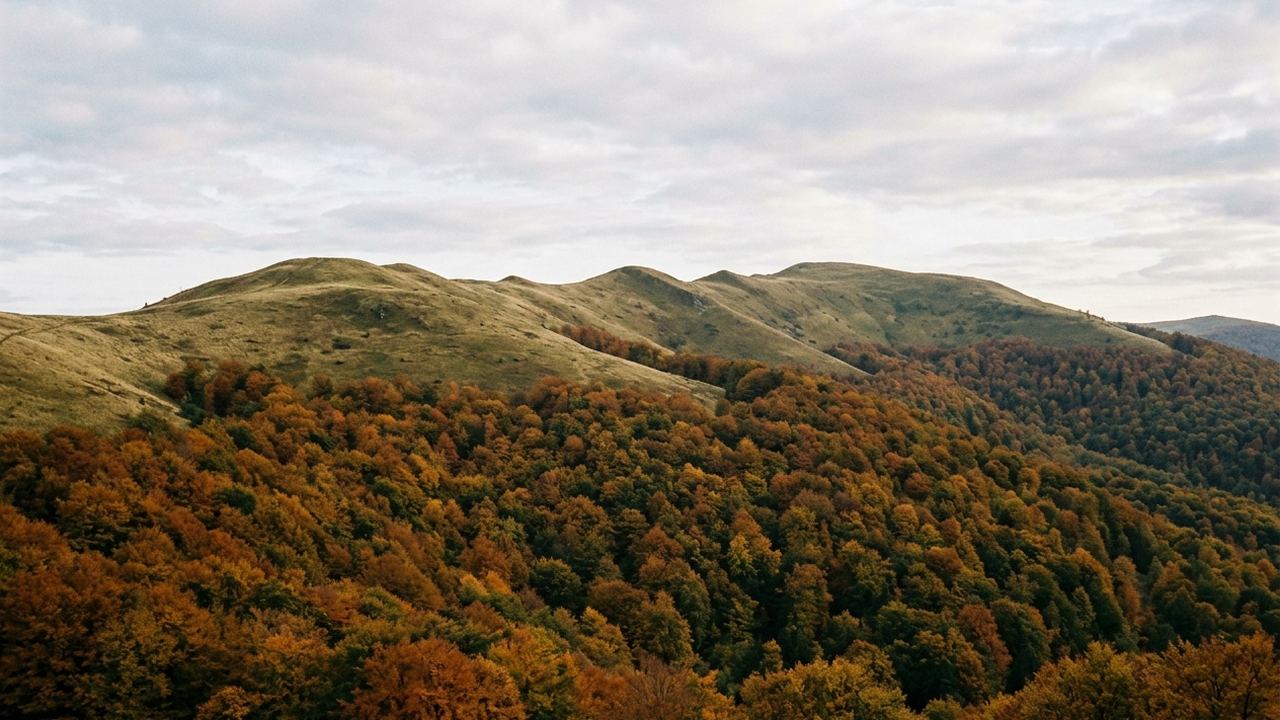
Most of the pictures show the grass. That is the part people come for and it is real: above about 3,600 feet the beech forest stops in a hard line and the tops are open pasture, called poloniny, running for miles with nothing standing on them. What the pictures leave out is that you spend more hours under the trees than on the grass. The climbs to the ridge are steep, dark and enclosed, and on a warm afternoon in June the air under beech is close and full of flies. You are typically two hours in the forest before you see anything at all.
The second thing photographs leave out is the emptiness of the valleys, which is not scenery. The Lemko and Boyko villages along these valleys were emptied by force in 1944 to 1947 and were never repopulated. What remains is often a line of fruit trees where a street was, a stone foundation under nettles, and a graveyard with the lettering worn off. There are wooden churches still standing at Smolnik and Turzansk, and a handful of others, and they are extraordinary buildings. But the ground between them is not wilderness, it is a place people were removed from, and the walking notes say so at each site rather than leaving you to guess why the meadows are so wide and so oddly flat.
The third thing is the driving. From Rzeszow to the first house is three and a half hours, and the last 30 miles are slow. Within the range there are almost no through roads: the main loop road takes you around the mountains, not across them, so a village eight miles away over the ridge is 45 minutes by car. This is why the luggage moves by road while you walk, and why the week is built as three stays of three nights rather than nine single nights.
- What the week is
- Nine nights in three family run guesthouses, three nights in each, with private rooms and shared bathrooms in two of them; you walk between valleys on marked trails while a driver takes the main luggage by road each moving day.
- What sets it apart
- The nearest useful airport is Rzeszow, and it is a three and a half hour drive to the first guesthouse, roughly 105 miles on two lane roads that slow to 25 miles an hour behind timber trucks. The high ground is grass and mud rather than scree, and it is genuinely wet: expect ankle deep runnels on the descents into beech. Beds are plain rooms in family houses, two shared bathrooms on a floor in two of the three. The walking season runs from the first week of May to the second week of October. Nine nights, from $2,690 per person.
- What the figure covers
- Nine nights of accommodation with breakfast; seven dinners cooked at the guesthouses; luggage moved by road on each of the three transfer days; airport pickup and drop off at Rzeszow; a local walking guide on four of the seven walking days; national park entry for the days it applies; printed 1:50,000 maps and marked route notes for every day; a written record of your booking from this office and the operating company's own terms in full.
- What it leaves to you
- Flights to Rzeszow, usually $780 to $1,400 round trip from the northeast in shoulder season; two dinners taken in village bars, about $14 each; all lunches, roughly $9 a day bought as bread, cheese and apples from village shops that shut at 4pm and do not open Sunday; drinks including the local beer at $2.50 and the sheep milk cheese sold at trailheads; the single room supplement of $520 for nine nights; travel cover of any kind, neither sold nor advised on from here; tips, which are not expected but are taken; and the roughly $30 taxi fare if you decide to skip a walking day and ride to the next village instead.
- Who this one is wrong for
- Do not reserve this if you cannot walk seven hours on rough wet ground carrying your own water and lunch. The longest day climbs 2,600 feet over 12 miles with no road crossing in the middle and no way to shorten it once you are on the ridge. There is no cell coverage for stretches of three hours, no cable car anywhere in the range, and the nearest hospital is 40 miles from the middle guesthouse. Two of the three houses have stairs and no lift. If a bad knee governs your walking, this week will govern it back.
Grass on top, mud underneath, and what a day here actually costs your legs
The rock under these mountains is flysch, alternating sandstone and shale, and it does two things to you. It holds water, so the trails hold water, and it weathers into a slick clay that will not drain even after three dry days. Ankle high boots with a hard sole are not a suggestion here, and a pair of walking poles will save you more on the descents than on the climbs. From late September the beech leaf fall covers the runnels entirely and you place your feet by feel for the last two hours of the day.
A typical day is nine to twelve miles with 1,800 to 2,600 feet of climb, and it takes six to eight hours because of the ground, not the distance. You start between 8 and 9, you are on the ridge by late morning, and the ridge walking is the reward: open grass, low bilberry, and views south into Slovakia and Ukraine that carry 40 miles on a clear day. Wind on the tops is the real weather. It is common to sit down in a hollow to eat because standing up in it is not comfortable, and a windproof layer matters more than a heavy fleece.
Weather in the range turns fast. Summer afternoons build thunderstorms with real regularity from mid June onward, and the ridge is exposed with no shelter for two hours in either direction, so the guide will start you early on those days and have you off the tops by 3pm. Temperatures on a July ridge run 60 to 72 Fahrenheit with the wind, and can sit at 45 in a cloud in early May. Snow lies on the north slopes into the first week of May in most years and the walking season is set around that.
The party this week fits, and the one it does not
This suits people who have walked hill days before but have never done a week of them abroad, and who are happy for the day to be plain: walk, eat bread on a rock, walk down, eat a large dinner at a table with the family who cooked it. It suits parties where one person wants a long day and another wants a short one, because on five of the seven walking days there is a road at the halfway point and the driver can collect one of you there. It suits people who do not want a marketed place and are willing to accept what comes with that, which is limited food, plumbing that is basic in two of the three houses, and almost no English spoken outside the guesthouses themselves.
It does not suit anyone who wants a resort at the end of the day, or a menu, or a room to themselves without paying $520 for it. It also does not suit anyone who needs to be there fast. Between the flight, the connection and the drive, most travelers from the northeast lose a full day at each end, and that is eleven days of leave for nine nights of walking. That is the arithmetic to check before anything else.
Six cells, one for each obstacle, filled where this trip answers. Read the words below rather than the strip; the strip is a shorthand.
- The dates are fixed and short
- does not. The guesthouses hold rooms in blocks and there are eleven departure weeks in the year, so if your leave is fixed to a single week in July you will probably find it already full. What does
- Somebody will not fly, or not far
- answers it. Everything else that answers it
- The party moves at two speeds
- answers it. Everything else that answers it
- Nobody has done this before
- answers it. Everything else that answers it
- The free weeks are out of season
- answers it. Everything else that answers it
- One person travelling
- does not. The rooms are priced for two and the single supplement is $520, which is the honest number and not a fee this office can talk the houses out of. What does
Which weeks are open, and what each of them takes from you
- Late April to first week of May
- Snow still lies in the north facing hollows above 3,300 feet and two ridge routes are closed. Guesthouses run half staffed. Cold, empty, and roughly $180 less across the week because two dinners move to a village bar.
- Second week of May to mid June
- The best walking of the year. Beech is bright green, the tops are dry by the end of May, and the meadow flowers are heavy. Storms are still rare. Book earliest for this window because the houses fill first.
- Mid June to end of July
- Warm, 70 to 78 Fahrenheit in the valleys, and thunderstorms most afternoons after the middle of June. Days start at 7:30. Horseflies in the forest sections are genuinely unpleasant for about three weeks.
- August
- Polish holiday month. The two accessible lakes and the main loop road are busy, the ridges are not. Guesthouses charge their high figure and the single supplement rises to $610. Water in the streams runs low by late August.
- First three weeks of September
- Warm days, cold mornings at 40 Fahrenheit, no flies, and the light on the grass is long all day. Second best window and the one this office reserves most often.
- Late September to mid October
- Beech turns copper and the forest is the point rather than the tops. Leaf fall hides the trail surface, so add an hour to every descent. Two guesthouses shut their upper floor and heating is wood only.
- Mid October onward
- The season closes. Roads to two of the three valleys are not cleared, the houses shut, and this office does not place reservations for these dates at all.
The border, the road, and the part nobody mentions in the pictures
Two of the ridge walks run within a few hundred yards of the Ukrainian border, and one runs along it. This is a real external border of the European Union, it is patrolled, and you will meet a border guard vehicle on the forest roads. Nothing about this is dramatic and no permit is required for the marked trails, but you must carry your passport on those two days and you will be asked for it, and there are stretches where stepping off the marked line to shortcut a bend is an actual offense rather than bad manners. We tell you this now because it surprises people, and because it means one of the best days on the ridge is not a day to wander.
The other thing is food and the shops. Village shops here open around 7 and shut at 4, they close on Sunday, and two of them close for an hour at lunch with no fixed time posted for reopening. If you have not bought lunch by 4pm the day before, you are walking on what the guesthouse can spare from breakfast, which is usually bread, cheese and an egg. There is no cafe on any of the ridge routes and nothing at all sells food above the treeline. Vegetarian eating is possible and the houses do it willingly, but it will be the same three dishes repeatedly across nine nights, and gluten free is difficult to the point where we would rather say so plainly than have you find out on day four.