Most people arrive expecting the Algarve and find something that has almost nothing to do with it. The southwest corner of Portugal, from Odeceixe down to Sagres, sits inside a protected natural park, and the protection has been in place long enough that the difference is visible from the first mile: no towers, no marinas, no seafront promenade. The towns are small and were fishing towns first. Some of them still are. What development exists sits back from the cliff because it was not allowed to sit on it.
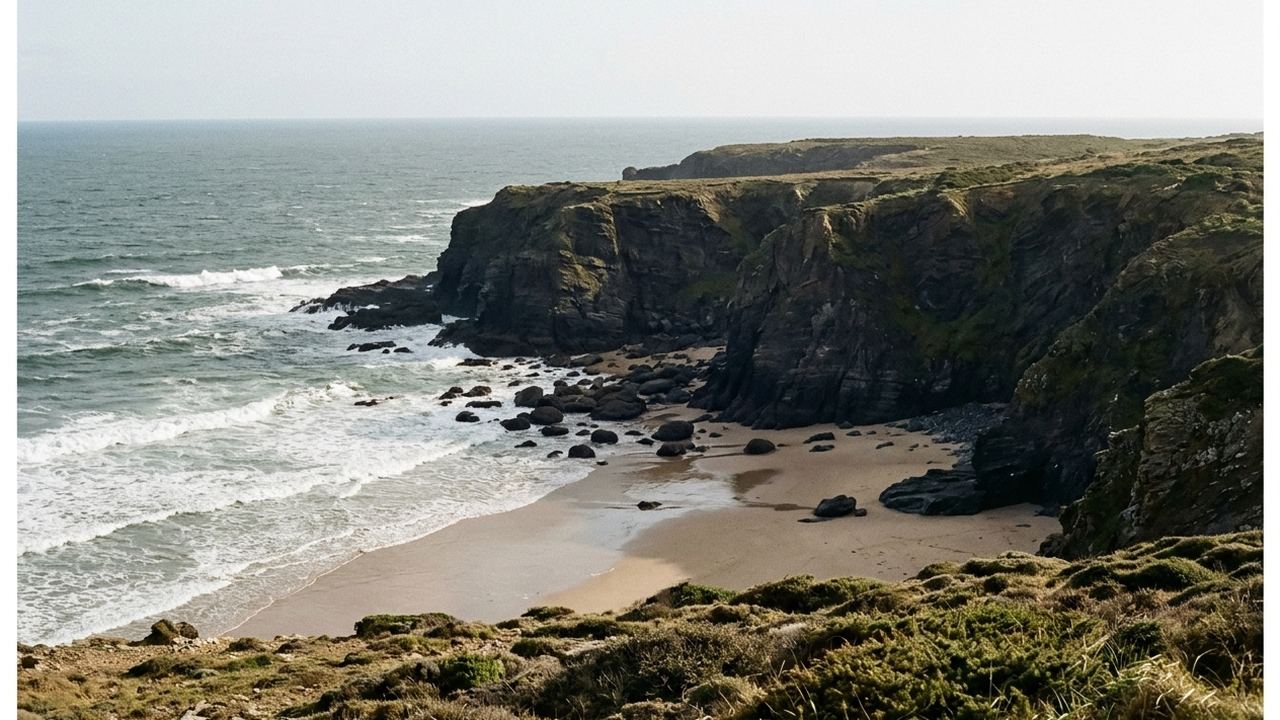
The second thing the photographs get wrong is the water. It looks Mediterranean and it is not. This is open Atlantic with a cold current running up it, and the sea sits around 61 to 64 degrees in high summer, colder in spring. People swim, but they swim briefly and they come out fast. If the week you are picturing involves floating around in warm water for an hour, this is the wrong coast and you should say so now rather than on day two.
The third is the wind. It blows most afternoons from the north and northwest, hard enough that walking south is noticeably easier than walking north, and hard enough that hats leave. It is not a storm and it is not dangerous on the marked path. It is simply constant, and it is the reason the cliff vegetation grows sideways and low. People who have walked in Ireland or Cornwall recognize it immediately. People who have not tend to underestimate what six hours of it does to them.
- What the week is
- Nine nights in five family run guesthouses along the coast, four of them for two nights, one for one night, walking eight to fourteen miles between towns on five of the days, with bags moved by road van each morning and returned by mid afternoon.
- What sets it apart
- The coast sits two and a half hours by road southwest of Lisbon and about an hour and a quarter west of Faro, and there is no rail line down it, so a transfer is unavoidable. The path is sand, packed dirt and cliff rock in roughly equal parts, with no shade for hours at a stretch. Beds are plain guesthouse rooms, tiled floors, no elevator in four of the five. The window runs March through late June and September into early November. From $2,140 per person, two sharing.
- What the figure covers
- Nine nights in guesthouses with private bathrooms; breakfast every morning; bag transfer between all five towns; a printed route book with the day by day mileage and the bail out points; offline maps loaded before you go; road transfer from Lisbon or Faro on arrival and again on departure; three dinners in the towns where there is only one place open; a local walking guide on two of the five walking days; a phone number in Portugal that answers during daylight hours if you lose the path.
- What it leaves to you
- Flights to Lisbon or Faro, generally $620 to $1,150 round trip from the northeast in shoulder season; lunches, which run $9 to $16 and must usually be bought the night before because nothing is open on the cliff; six of the nine dinners at $18 to $35; all drinks; the single room supplement of $410 for the nine nights; taxis on the two days people commonly quit early, roughly $30 to $55 a leg; entrance to the two small museums, $4 each; anything to do with entry documents or medical cover, which this office does not arrange or advise on.
- Who this one is wrong for
- Do not book this if you cannot walk eight miles on soft sand and loose cliff rock, five days out of nine, with three to five hours between any two places where you can sit down indoors. Several sections run within ten feet of an unfenced drop of eighty feet or more, and there is no inland alternative for about four miles of that. Anyone with a serious fear of heights will spend those hours miserable. There is no way to shorten day four below eleven miles.
What the ground under your feet is actually doing
The long distance path along this coast is a genuine cliff path, not a coastal road with a view. Large stretches of it cross deep sand, the kind that gives under the ball of the foot and forces a shorter stride, and a mile of that costs roughly what two miles of packed track costs. The route book gives both the mileage and an honest time estimate for each day, and the time estimate is what you should plan around. Day four is eleven miles and takes most parties six and a half to eight hours.
Other stretches run on flat rock a few feet in from the edge. The edge is not fenced and in most places nothing marks it except the point where the ground stops. The drops are between forty and two hundred feet depending where you are. In good visibility this is perfectly manageable and thousands of people walk it every year. In fog, which arrives in the morning more often in spring, the sensible move is to take the inland variant, and the route book shows where those exist. On four miles between Carrapateira and the north side of Sagres, they do not.
The days themselves are shaped by the fact that there is nothing in the middle. You leave a town in the morning with water and food you bought the previous evening, and you arrive in the next town in the afternoon, and between those two points there is generally no cafe, no shop, no shelter and no reliable shade. Carry three liters in warm weather. The two guided days are the two where the navigation is least obvious, not the two that are hardest.
The kind of party this week actually works for
It works best for one or two people who walk regularly at home and want a week where the decisions are already made. The order of the towns, the beds, the bag van and the transfers are fixed before you leave, and the only daily choice is what time to start. That is the whole appeal for somebody who has never done a walking week before and does not want to be the person holding the map and the blame.
It also works, unusually well, for a single traveler. The supplement is $410 and that is a real cost, not a hidden one, but the guesthouses are small and the towns are small and you will end up eating near the same four or five people all week whether you planned to or not. The office will say plainly if a departure has nobody else on it.
Six cells, one for each obstacle, filled where this trip answers. Read the words below rather than the strip; the strip is a shorthand.
- The dates are fixed and short
- does not. The window is nine nights and cannot be run in seven, because the two shortest legs are the ones with no road access and no bed in between. What does
- The party moves at two speeds
- does not. The party walks the same cliff path or does not walk at all, and the person who cannot do the ascent out of Odeceixe has a two hour wait in a village with one cafe. What does
- Nobody has done this before
- answers it. Everything else that answers it
- The free weeks are out of season
- answers it. Everything else that answers it
- One person travelling
- answers it. Everything else that answers it
Which weeks are worth taking and which are not
- March to mid April
- Green, cool, and the wildflowers on the cliff top are at their best. Fog on maybe one morning in four. Water at 59 degrees. Some guesthouse restaurants have not opened yet. Lowest room rates of the year. Mid April to end of May | The strongest weeks on this coast. Long daylight, air in the low seventies, storks on the sea stacks with chicks in the nests. Everything open. Rooms are at their most expensive and book out four months ahead. June | Still good walking, still windy, and the beaches begin to fill on weekends. Air in the mid seventies. Prices sit just under the May figure. Start earlier in the day than you think you need to. July and August | Not offered. Air inland hits the nineties, the cliff has no shade at all, and every bed on the coast is taken by Portuguese and Spanish families who booked in February. September to mid October | The other strong window. Warmest sea of the year at 66 degrees, emptier than May, air in the mid seventies. Occasional first Atlantic swell. Rooms roughly ten percent under the spring figure. Mid October to early November | Empty and often beautiful, with a real chance of two wet days in the nine. Daylight is short enough that day four needs an early start. Several restaurants close for the season from the last week of October. Mid November to February | Not offered. Storms come in off the Atlantic, the cliff sections get genuinely unsafe in wind, and most of the guesthouses are shut.
The transfer nobody factors in, and the day that catches people
The road transfer is the part people forget when they compare this to a week somewhere with a train. Lisbon airport to Odeceixe is two and a half hours in a van, and it comes at the end of a long flight. Faro is shorter at about an hour and a quarter, but flights into Faro from the United States generally connect through somewhere in Europe and cost more time than they save. Whichever way you come in, expect the first day to be travel and nothing else. That is why the week is nine nights and not seven: two of them are largely spent getting there and getting out.
The other honest drawback is day four. It is eleven miles, there is no road that meets the path in the middle of it, and there is no bed between the two ends. If somebody in the party is struggling, the options are to keep going or to turn back the way you came, and both are long. This office will not pretend otherwise, and if that single day is the thing standing between you and booking, the reasonable answer is that this is not the right week rather than that it will probably be fine.