The photographs of this part of Belgium are all taken at dawn in October, when mist sits on the water and the brick reflects orange, and the town squares are empty. Those squares are not empty. Bruges takes something close to eight million visitors a year into a medieval core about a mile across, and between eleven in the morning and five in the afternoon the main streets move at the speed of a slow walk. What the pictures leave out is the reason this week works anyway: the towpath starts about four hundred yards from the middle of every one of these towns, and once you are on it the crowd stops dead. You can be alone with a heron and a line of poplars fifteen minutes after leaving a square with a thousand people in it.
The second thing people get wrong is the distance. Looking at the map, the cloth towns of Flanders feel like they should be spread across a country. They are not. Bruges to Ghent is 30 miles. Ghent to Kortrijk is 27. Ypres sits about 40 miles southwest of Bruges. The whole triangle these canals draw would fit inside a single county at home, and the trains crossing it run every thirty minutes on the main lines, most of the day, on a fare that would not buy a sandwich at an American airport. That density is the actual product. Nobody has to earn a town by riding to it.
And the ground is genuinely flat. Not gently rolling, not mostly flat. The highest point anywhere near this route is under 200 feet, most of the riding sits between sea level and 30 feet, and a stretch of twelve miles of towpath can pass without a single gradient a rider would name. The one thing that takes the place of hills is wind, and it takes that place seriously.
- What the week is
- Nine nights across four towns, in family run hotels and one converted brick warehouse, moving between bases by regional train while a van carries the suitcases door to door, with rented bicycles collected and dropped at each base.
- What sets it apart
- Brussels airport sits 60 to 80 miles from the four bases, and every one of them is reachable by direct or single change train in under two hours. The towpath surface is asphalt or hard packed brick, level within about ten feet across the whole route, and closed to cars for long stretches. Beds are twin or double in small hotels of eight to thirty rooms, all with an elevator except the warehouse, which has two floors and no lift. The route runs March through early November; from $2,180 per person.
- What the figure covers
- Nine nights with private bath and breakfast; a hybrid bicycle with pannier, lock and lights for eight of the nine days; all regional train travel between the four bases and along the route; luggage moved by van between bases; a paper route book with the towpath junctions drawn out; one guided walk through a working brewery cellar with three tastings; museum entry in three towns; one evening meal in the warehouse town; a local contact number for the bicycle rental firm.
- What it leaves to you
- Flights to Belgium, roughly $620 to $1,100 round trip from the northeast in season; airport transfer or train from Brussels, about $22 to $34 each way; lunches and most dinners, budgeting $18 to $45 a head; the single room addition of $560 for the nine nights; bicycle damage waiver at $9 a day if you want it; canal boat trips in two of the towns at $14 to $19; museum entry beyond the three included, generally $10 to $16; anything to do with entry documents or medical cover, which this office does not advise on.
- Who this one is wrong for
- Do not book this if nobody in the party can ride a bicycle on their own. The flat riding days run 18 to 34 miles, four to six hours in the saddle including stops, on a surface shared with commuters and school traffic. Two of the four bases have stairs to some rooms and one has no elevator at all. Wind off the North Sea runs steady at 15 to 25 miles an hour for days at a time and there is nothing to shelter behind, which tires riders more than any hill would.
What a riding day is actually made of
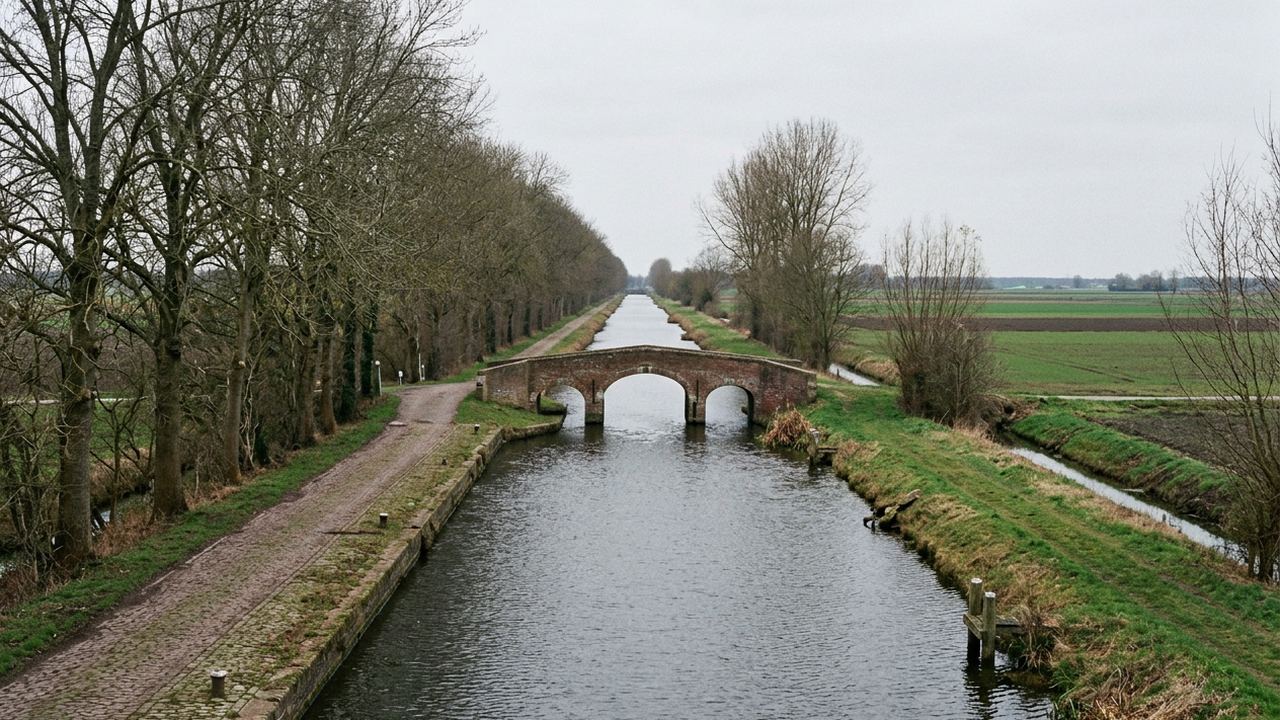
A day begins with the van coming for the suitcases, usually between eight and nine, and ends with those suitcases already in the next room. Between the two is a stretch of water. Most days you leave a town along a canal cut in the twelve or thirteen hundreds to move wool inland from the sea, and you follow it with the water on one side and farmland on the other. The path is asphalt for most of its length, brick where it passes through a village, and about ten feet wide. It carries commuters at eight in the morning, school children at four, and almost nothing at midday. There are no cars on the long sections and the crossings are signposted in a numbered node system that the route book decodes for you: you ride from junction 42 to junction 68 to junction 71, and each junction has a post with a map on it.
Weather is the honest variable. April and May run 50 to 65 degrees with long clear spells and a fair chance of a soaking. July and August sit between 65 and 80, which sounds ideal and mostly is, though a hot week here is humid and the shade on a towpath is intermittent. October drops to 45 to 58 and the light gets extraordinary, low and sideways off the water for hours. Rain in Flanders is rarely dramatic; it is a fine steady thing that arrives on about one day in three across the whole season and passes in an hour or two. A rain jacket matters more than a heavy coat.
The wind deserves its own paragraph because it is the one thing that makes a flat route hard. The prevailing direction is southwest off the North Sea, it blows almost every day, and on a bad stretch it runs 20 to 25 miles an hour with gusts higher. Riding into it on an open towpath with no hedge and no hill is slow, monotonous work, and a rider who expected an easy flat week can find themselves grinding at 8 miles an hour for two hours. This is precisely why the train card is in the price rather than an add on. Days when the wind is wrong, you put the bicycle on the train, which is permitted on regional services outside the morning rush for a small supplement, and you ride the last five miles into town instead of the whole thirty.
The parties this week was built around
This is a week for a party that cannot agree on how hard it wants to work. Because every base sits on a rail line and every riding day parallels one, the walkers and the riders can separate at breakfast and meet in the same square at five. One person does 34 miles along the water, another takes the 26 minute train, spends four hours in a museum, and neither has compromised. That is not a rhetorical flourish, it is the actual reason the four bases were chosen: each pair is connected both by towpath and by direct train.
It also suits a party who has not done this kind of trip before and does not want the responsibility of inventing it. The route book is drawn out junction by junction, the beds are booked, the luggage moves without anyone arranging it, and the decision left to the traveler each morning is small and reversible: ride, or take the train, or ride half. Nobody has to commit at breakfast to something they cannot undo at lunch.
Six cells, one for each obstacle, filled where this trip answers. Read the words below rather than the strip; the strip is a shorthand.
- The dates are fixed and short
- answers it. Everything else that answers it
- Somebody will not fly, or not far
- answers it. Everything else that answers it
- The party moves at two speeds
- answers it. Everything else that answers it
- Nobody has done this before
- answers it. Everything else that answers it
- The free weeks are out of season
- does not. The bicycle rental firms close their counters from late November to the end of February and the towpaths ice over, so the week cannot run in the months this office would otherwise send you. What does
- One person travelling
- does not. The single room addition of $560 is real money on a nine night week and there is no shared room option, since these are small hotels holding rooms in twos. What does
Which weeks are worth having and which are not
- Early March to mid April
- Cold and bare, 40 to 55 degrees, but the towpaths are yours and the museums have no line at all. Rental counters open around the tenth of March. The lowest figure of the year, near the floor price.
- Late April to early June
- The strongest weeks. Long light until nine at night, 55 to 68 degrees, the poplars in leaf, and the towns busy but not overwhelmed. Expect $250 to $400 above the floor figure.
- Mid June to mid July
- Warm, 65 to 78, and every school in northern Europe is about to break up. Ghent fills for its ten day street festival in the second half of July, which is genuinely good and makes beds there scarce and dear.
- Late July and August
- The peak. Hotel rates in Bruges roughly double, the medieval core is at capacity from ten in the morning, and the towpaths are still empty. Add $500 to $700 per person and book far ahead.
- September to mid October
- The other strong window. 52 to 66 degrees, harvest in the fields, water like glass in the mornings, the crowd thinned out after the first week. Roughly the same figure as late spring.
- Late October to early November
- Short days, sunset before six, 42 to 55 degrees and a real chance of three wet days in nine. Cheap, beautiful, and only for people who genuinely do not mind riding in weather.
- Mid November to end of February
- The week does not run. Rental counters shut, towpaths ice in the shaded sections, and several of the small museums close two days a week.
The part of this week that annoys people
The single room addition is the honest sore point. It is $560 across nine nights, which is roughly a quarter added to the floor figure, and there is no way around it. These are hotels of eight to thirty rooms in old buildings where the small rooms are genuinely small and the operators will not hold one for a lower rate in a busy season. Anyone traveling by themselves should decide about that number before anything else, because it does not shrink.
The other one is the bicycle itself. The bicycles are ordinary hybrids with seven or eight gears, upright bars, a rack and a bell. They are well maintained and completely adequate for flat ground, and they are not what a rider who owns a good road bicycle at home is used to. They are heavy, the saddles are broad and firm, and after four hours a person accustomed to their own fitted saddle will notice. Bringing your own saddle and pedals is common and takes ten minutes to fit at the rental counter. Bringing an entire bicycle is possible but the airline handling and the assembly at the far end usually costs more in money and temper than it returns.