The photographs of this valley are almost always of one thing: the scratched white patterns on a house front in Guarda or Ardez, taken in late morning with the shutters open. That decoration is real and there are streets of it. What the photographs do not show is that these are working villages of two to nine hundred people, that the house you are looking at is somebody's home, and that after five in the afternoon in October there is nobody on that street at all. The valley does not perform. It is still in a way that some people find restful and others find like a held breath.
The second thing people get wrong is the language. Romansh is not a dialect of German. It is a separate Romance language descended from the Latin of the Roman province, and in the Lower Engadine the variety spoken is Vallader. It is the everyday language of the shop and the school in Sent, Ardez, Guarda and Ftan. Signs are in it. The bus stop is a fermada. Nobody expects a visitor to speak it, and German and English both work everywhere, but a person who arrives thinking this is a German speaking region will be corrected politely and repeatedly.
The third is scale. The whole lower valley from Zernez to the Austrian border is about twenty five miles of river, with the villages perched on terraces two to six hundred feet above the water. This is not a place you cross in a day of driving, because you are not driving, and it is not a place you exhaust in nine nights either. Most guests who come for a week walk the same three or four valleys and go home wanting the others.
- What the week is
- Nine nights in two villages, five in one and four in the next, in family run guesthouses with private bathrooms, moving between them by scheduled train with luggage carried by the traveller, one bag each, on a platform ramp.
- What sets it apart
- Most people who say Engadine mean the upper valley around the lake chain, which sits at 5,900 feet and fills in winter. The lower valley runs from Zernez down to Martina at the Austrian border, dropping to 3,400 feet, and it is a different climate: drier, warmer in summer, and thin on hotel beds. Arrival is by rail from Zurich in about four hours with two changes, or from Landquart in two. The ground is steep everywhere off the valley floor. Beds are guesthouse rooms, wood lined, mostly small. The season runs late May to late October, and the figure is $2,780 per person.
- What the figure covers
- Nine nights in two family run guesthouses with private bathroom and breakfast; all second class rail from Zurich airport or Zurich main station into the valley and back; a valley transport pass covering every postbus and local train for the nine days; the national park entrance arrangements and one guided park walk with a licensed park ranger in English; three dinners at the guesthouses; a printed set of walking routes with times and elevation gains keyed to the postbus timetable; the transfer of the party between the two villages by scheduled train; the written itinerary with every departure time listed; and a Swiss telephone number for the ground operator, staffed during Swiss business hours.
- What it leaves to you
- International flights to Zurich, roughly $780 to $1,400 round trip from the northeastern United States depending on month; six dinners, budget $34 to $55 a head at guesthouse prices and $25 at a village grocery; all lunches; alcohol; the mineral baths at Scuol, $38 for three hours and $52 for the full circuit; cable car tickets at Motta Naluns and Ftan, $31 to $46 return; single occupancy, which adds $610 across the nine nights; travel to and from your US departure airport; and anything at all in the way of insurance, which this office does not arrange or advise on.
- Who this one is wrong for
- Do not book this if stairs are a problem. Engadine guesthouses are old buildings and the ones worth staying in have two or three flights with no elevator, narrow treads and a turn at the landing. Most walking here starts with a climb: the shortest useful route out of Scuol gains 1,300 feet in the first two miles, and the park walks run five to seven hours with 1,600 to 2,400 feet of ascent on loose stone. If somebody in the party cannot manage a full flight of stairs carrying a bag, this valley will not work.
What the ground does to a day here
The valley floor sits between 3,400 and 4,900 feet and the peaks around it reach 10,000. Almost nothing here is flat. The two exceptions are the riverside path along the Inn, which runs for miles at a gentle grade and is the only route in the region a person can walk without gaining height, and the terrace paths that link Guarda, Ardez and Ftan, which undulate but do not climb hard. Everything else goes up. A typical day is a postbus to a valley mouth in the morning, a climb of 1,500 to 2,500 feet over two to four hours, lunch out of a bag, and a descent to a different bus stop for the afternoon return.
The postbuses are the reason this works without a car, and they are worth understanding before arrival. They run to a printed minute and they are not approximate. If the timetable says 16:47 at Ftan Baraigla, the bus is there at 16:47 and it does not wait. Missing the last one out of a side valley in September means a walk of eight to twelve miles down a road in the dark. Every route in the printed set you receive is built backward from a bus, with the latest safe start time marked on it.
Weather is drier than the Swiss average because the valley sits behind the main Alpine ridge, and the summer pattern is clear mornings and thunderstorms after two in the afternoon. In July and August you plan to be off the high ground by early afternoon. Daytime highs in the villages run 68 to 77 in midsummer, dropping to 45 to 55 in October, with hard frost at night from the end of September. Snow can fall above 7,500 feet in any month of the year and does, most years, at least once in August.
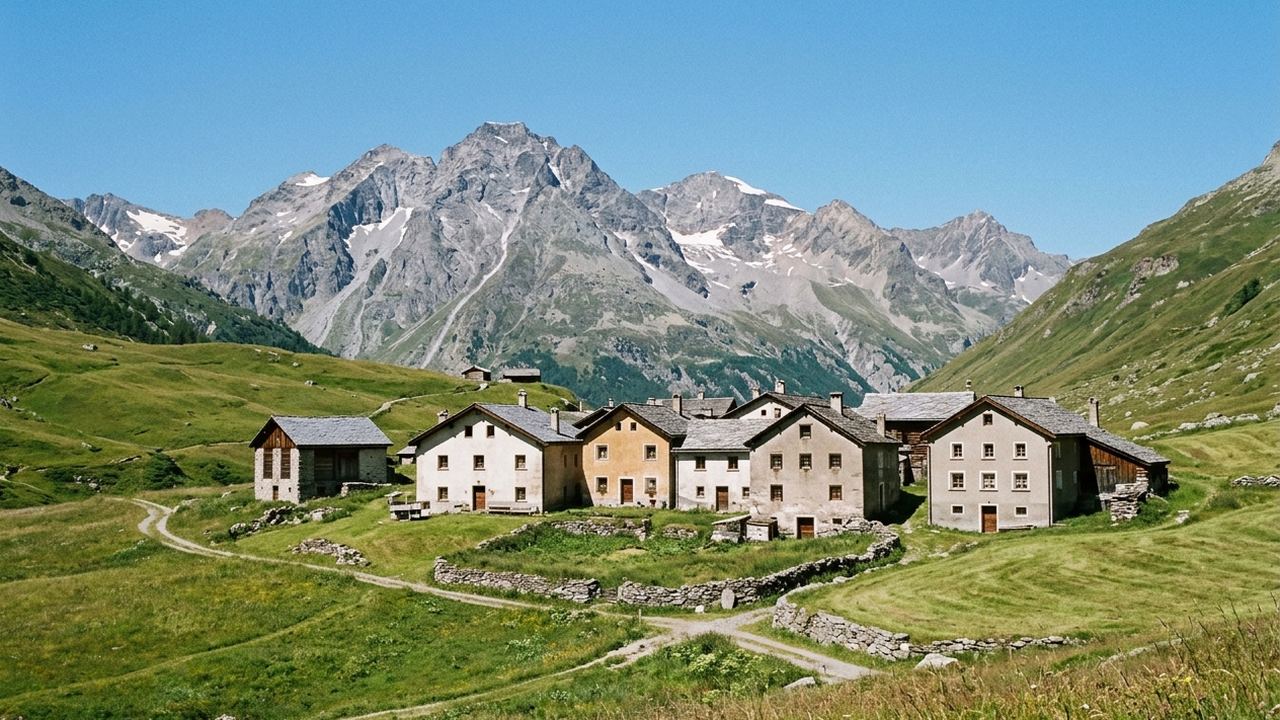
The kind of week this actually is
This suits somebody who wants to be somewhere specific rather than somewhere impressive, and who is comfortable with the fact that the entertainment is walking, looking at houses, and eating at seven because the kitchen closes at nine. It suits a person who has not organised a trip like this before, because the whole thing is timetabled: you receive a written itinerary with every train and bus departure on it, and the two guesthouses expect you on the days named. There is nothing to work out on the ground except which walk to take.
It also suits anyone who will not get on a long flight but will get on a train. From Zurich the valley is four hours by rail with two changes, and the connections are built into the ticket. From anywhere in western or central Europe the whole trip can be done on the ground. What it does not suit is a party moving at two different speeds, and the reasons are in the block below.
Six cells, one for each obstacle, filled where this trip answers. Read the words below rather than the strip; the strip is a shorthand.
- Somebody will not fly, or not far
- answers it. Everything else that answers it
- The party moves at two speeds
- does not. The postbus reaches the trailheads but not the ridges, so a party split between a walker and someone who cannot climb spends most of each day apart with no easy midpoint. What does
- Nobody has done this before
- answers it. Everything else that answers it
- The free weeks are out of season
- answers it. Everything else that answers it
- One person travelling
- does not. Guesthouse rooms here are doubles, single rooms are rare in the villages we use, and the supplement of $610 is a real charge that cannot be argued down. What does
Which weeks are worth the money and which are not
The season here is short and lopsided. The high summer weeks are the ones everybody assumes they want, and they frequently give you less daylight and worse weather for the same figure.
- Late May to mid June
- Meadows in full flower, snow still on north facing paths above 7,200 feet, several high routes closed. Guesthouses emptiest of the year and rooms easiest to hold. Expect two wet days in nine.
- Mid June to mid July
- Everything open, long light until nine thirty, park walks at their best. Afternoon storms begin. This is the strongest fortnight and rooms in Guarda and Ftan go five to seven months ahead.
- Mid July to late August
- Warmest, busiest, and the only period when the villages feel crowded at midday. Storms most afternoons after two. Add roughly $190 per person to the figure.
- September
- The month most repeat guests choose. Cold clear mornings, stable air, larches still green, park wildlife active at the treeline. Frost at night from about the twentieth. No premium on the figure.
- Early to mid October
- The larches turn and the valley is at its most photographed. Postbus frequency drops on some side routes, so days need planning around fewer departures. Two guesthouses shut mid month.
- Late October to late May
- The lower valley is not offered. Most guesthouses close, side valley bus routes stop, and the walking this week is built around simply does not exist under snow.
The national park is stricter than anybody expects
The Swiss National Park begins a short distance up the valley from Zernez and it is not a park in the American sense. There are no picnic tables, no side trails, no camping, no fires, no dogs, no bicycles, no drones, and no leaving the marked path for any reason, including to photograph something or to relieve yourself. Rangers enforce this and fines are issued. Nothing may be picked or taken, not a flower, not a stone. The included guided walk exists partly because a ranger explains all of it on the ground in the first twenty minutes, which is more use than reading it here.
The expensive annoyance is different, and it is worth saying plainly: this is Switzerland and the daily costs outside the figure add up faster than most American visitors expect. A guesthouse dinner is $34 to $55 without wine. A half litre of beer is $9. A sandwich and a coffee in Scuol is $19. Six dinners, nine lunches and drinks will realistically add $600 to $850 per person on top of the price above, and no amount of planning makes that number much smaller. The one genuine saving is that the village groceries are good and every guesthouse room in this week has somewhere to sit and eat a bought lunch, which is what most guests end up doing by day four.