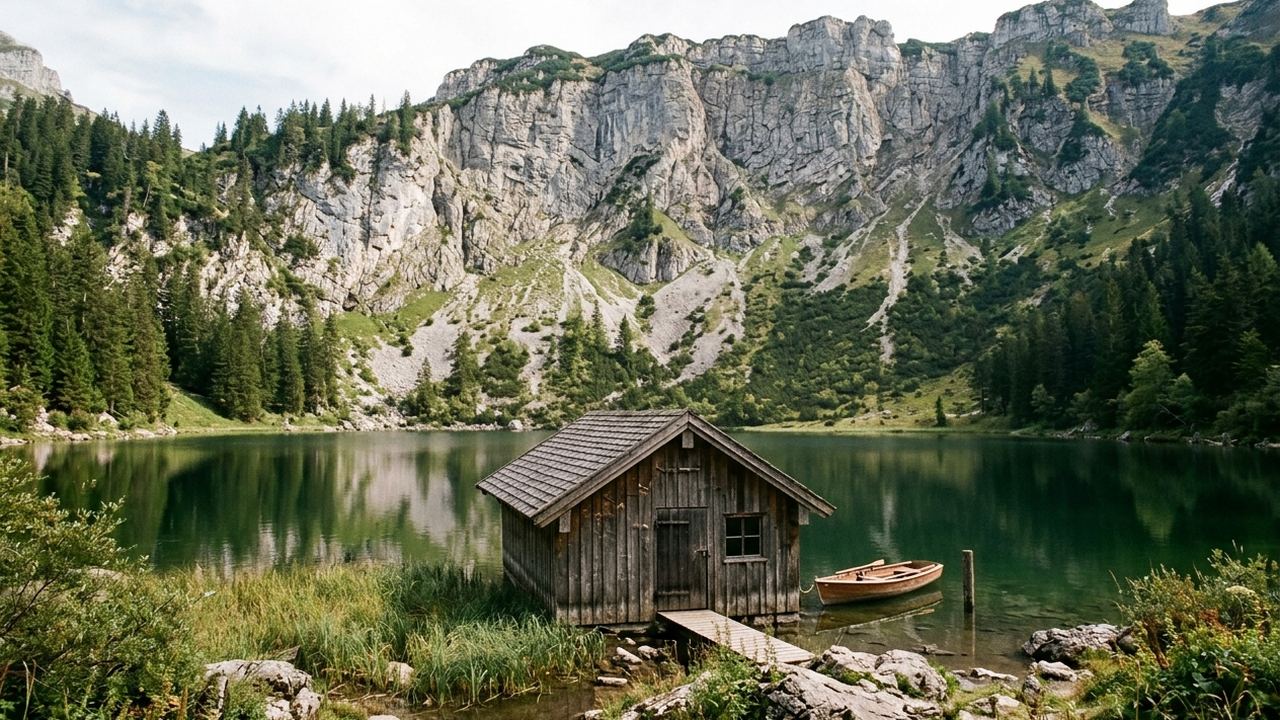
The photograph that sells this region is taken from about two hundred yards of lakeside path on the northern edge of Hallstatt, a village of roughly seven hundred and fifty residents standing at the foot of a limestone wall. It is a real place and the photograph is not a lie. It is simply very small, and it is one village in a district that counts seventy six lakes across parts of three Austrian states. This week spends one early morning there and eight days somewhere else.
The second thing people have wrong is the distance to Salzburg. Bad Ischl, where the week starts, sits 35 miles from the airport, and no direct train has ever run between the two. The road bus takes an hour and forty minutes and leaves roughly every half hour. Inside the region the railway is single track, runs north to south through Gmunden, Ebensee, Bad Ischl and Bad Aussee, and puts a train through most stations once an hour. None of that requires a car. All of it requires reading a timetable, which is what the written schedule inside the figure is for.
The third is the water. These lakes are fed by snowmelt and by springs coming out of karst, and they do not warm the way a shallow lake warms. The Hallstätter See sits at 66 to 70°F on the surface in the last week of July and falls into the mid fifties about eight feet down. The Attersee, twelve miles long and the clearest of them, is a diving lake for exactly that reason. People swim in all of them in August. They do not linger.
- What the week is
- Nine nights in two family run guesthouses, six in Bad Ischl and three above the Attersee, both rooms with private bath and breakfast; the party moves once, by scheduled train and bus, carrying its own bags on that single day.
- What sets it apart
- Salzburg airport is 35 miles from Bad Ischl and there is still no direct train between them: the road bus takes an hour and forty minutes. Beds are in two guesthouses of eleven and nine rooms, not hotels, with breakfast at a shared table. Lakeside paths are flat and paved; everything above them is wet limestone with polished roots. Boats and cable cars run from late April to the third week of October. From $2,940 per person.
- What the figure covers
- The figure covers nine nights for two sharing, private bath and breakfast at both houses; a regional pass valid on the trains, the road buses and the scheduled lake boats for the whole stay; the transfer from Salzburg airport on arrival and back again on departure; the salt mine above Hallstatt, overalls and underground train included; the rack railway to the summit above the Wolfgangsee, return; the cable car at Obertraun with entry to the ice cave; one half day on foot with a licensed local guide; a written schedule carrying the actual train and boat times for your dates; and every reservation placed and confirmed in writing with the operating company.
- What it leaves to you
- It does not cover the flight to Europe, which has run $760 to $1,420 round trip out of the northeast in the months this week runs; lunches and dinners, realistically $32 to $60 per person per day; the single supplement of $580 for a room used alone; entry to the emperor's summer villa at Bad Ischl, $23; the thermal bath there, $34 an afternoon; laundry at about $14 a load; anything the weather makes you buy or rebook on the day; and insurance of any kind, which this office does not sell and does not advise on.
- Who this one is wrong for
- Do not book this if stairs are the problem rather than distance. The ice cave at Obertraun is roughly 700 steps in and out at 34°F, with nowhere to stop halfway. The salt mine walks in about a mile at 47°F and comes out down two wooden slides. The lanes of Hallstatt are stone stairs without handrails and they are slick in rain. If one of you cannot manage 300 steps in a day, three of the four fixed admissions are money spent on nothing.
Wet limestone, and what a day here costs your legs
There are two kinds of ground in this valley and they behave nothing alike. The lakeshore paths are flat, paved or firm gravel, and four to seven miles of them can be walked in an afternoon without a single climb. Above them the ground is limestone: fissured, wet for most of the year, with tree roots worn smooth by boots. A marked path gaining 2,000 feet takes an ordinary walker two and a half hours going up and nearly as long coming down, because the descent is where limestone does its damage. The cable cars at Ebensee and above Bad Ischl remove the climb and leave the ridge, which is the part worth having: two to three hours of walking at 4,900 to 5,600 feet with the lakes lying underneath.
Breakfast at both guesthouses runs from half past seven to half past nine, which sets the day. Trains are hourly, lake boats every sixty to ninety minutes in season, and the last scheduled boat off the far shore of the Wolfgangsee leaves around ten past six in September. Nothing in this week is more than seventy minutes from either bed. That is the practical point of the whole arrangement: an afternoon that goes wrong can be abandoned at two o'clock without costing the day.
Bad Ischl takes about 60 inches of rain in a year. Rochester, where this office sits, takes 34. In June and July the shape is a clear morning and a thunderstorm somewhere after two, and the boats keep running through it. In the first half of October the valley can hold fog at 45°F for three days at a stretch while the ridge above it stands in sun at 60°F, which is the one week of the year a cable car ticket earns its keep on the morning you least want to buy it.
Who ends up on this week
Parties that do not move at one speed do well here, and it is the geography doing the work rather than any kindness on our part. On every day of this itinerary there is a boat, a paved promenade and a bench looking at the same wall of rock the fast half of the party is standing on. The four fixed admissions are priced per head: if one of you is not going into the ice cave, $52 comes off the figure instead of being kept without a word. It also suits people who have never put a trip like this together themselves, because everything runs on public transport with printed times, English is spoken in all the lake towns, and the region is small enough that boarding the wrong train costs an hour rather than a day. If your free weeks fall outside July and August, this is one of the few trips on the site that is better for it: the second half of May and the last ten days of September are the two spans we would steer you toward.
Two things in this valley are not scenery. There is a memorial at the site of the camp at Ebensee, twenty minutes down the lake from Bad Ischl by train, and there is the chamber in the Altaussee salt mine where looted art was stored in 1944. Both can be visited, neither is on the schedule, and the office will tell you how to reach either one if you ask for it.
Six cells, one for each obstacle, filled where this trip answers. Read the words below rather than the strip; the strip is a shorthand.
- The dates are fixed and short
- does not. Nine nights plus two days in the air will not compress into a week: cut it and you spend a third of the trip recovering from the crossing and the rest packing. What does
- Somebody will not fly, or not far
- does not. There is no way in that is not a transatlantic flight of at least eight hours, and nothing on this side of the water reaches Austria by sea or by rail. What does
- The party moves at two speeds
- answers it. Everything else that answers it
- Nobody has done this before
- answers it. Everything else that answers it
- The free weeks are out of season
- answers it. Everything else that answers it
The calendar decides more of this than you do
Almost everything here is seasonal machinery: boats, cable cars, mountain huts and one of the two mines all open and shut on dates, and the dates are not the same dates.
- Late April to the end of May
- Boats restart and the high paths are still muddy. The daffodil meadows around Bad Aussee peak in the final week of May. Rooms are least contested, and rain falls roughly every third day.
- June
- Longest light, everything open, huts unlocked from mid month, thunderstorms most afternoons after two. Lake water sits near 62°F, which is honest swimming rather than pleasant swimming.
- July and August
- Day buses stack up in Hallstatt from nine in the morning. Lakes reach 68 to 74°F. Room rates peak across the region and the figure quoted above does not hold in these weeks.
- September
- The steadiest month here. Water still near 68°F in the first ten days, crowds gone by the tenth, boats on full timetable, huts open until the end. Costs return to the figure above.
- The first three weeks of October
- Larch turns yellow on the slopes, valley fog most mornings, boats thinning to a weekend service after the tenth. The mine above Hallstatt takes its final visitors around the end of the month.
- November
- The dead stretch. Boats stopped, cable cars stripped for servicing, fog on the valley floor for days together, several guesthouses shut. This week is not sold in November at any figure.
- December and early January
- Markets on the lakeshores, masked runs through the villages in the first week of December, a procession of lit headdresses at Ebensee on the fifth of January. Valley snow below 2,300 feet is unreliable.
- February and March
- Empty and cold, small lifts turning, lakes the color of slate. The salt mine above Hallstatt stays closed until spring, so a third of this week is simply unavailable.
The village everybody photographs, and the money nobody counts
Something close to a million day visitors reach Hallstatt in a year, against those seven hundred and fifty residents. Between about nine in the morning and five in the afternoon through the summer the single lane along the water is a slow queue of people photographing each other, and a fair number of them have come from Salzburg and back inside one day. This week puts you on the first boat across from the railway station, which lands a little after eight, and has you up at the mine before the coaches arrive. If you want the village at midday in August you will get a crowd and a view of the crowd, and no amount of scheduling repairs that.
The admissions here are not small money. The ice cave and its cable car come to about $52, the rack railway about $54, the mine about $40, and the regional pass covering trains, buses and boats about $110 for the stay. That is roughly $256 a head before a single meal, which is why all of it sits inside the figure instead of surfacing later as a surprise. Two other real numbers: a room used alone adds $580 across the nine nights, because the room is priced for two and the guesthouse will not pretend otherwise; and if the week you can travel turns out to be six wet days out of nine, you will spend most of it in a mine, a bath and a museum. All three are worth doing. None of them is why you came.
The request form runs 24/7 and never closes. Whatever arrives is read by a person before the end of that working day, and a written figure priced against your particular dates takes two to four working days.