Most people arrive believing the mountains here are small. The number that gets quoted is 3,560 feet, which sounds like an afternoon to anyone who has driven to 8,000 feet in Colorado and walked the last thousand. The number is honest and the conclusion is wrong. The sea is four miles away and the ground starts at it. There is no road that lifts you halfway. Whatever the summit says, you climb all of it, and you climb it on rock that is wet more often than it is dry.
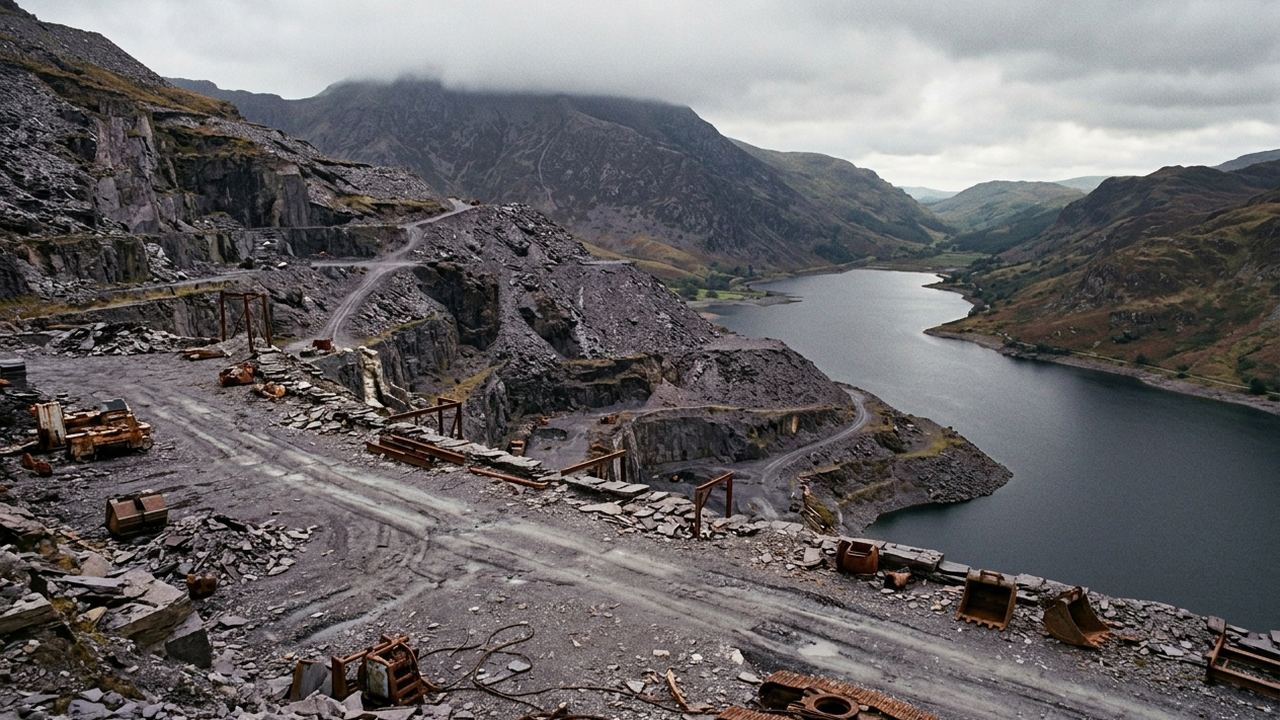
The second thing the photographs leave out is the slate. Whole hillsides in the middle of this region have been taken apart by hand and stacked back up as gray waste, tier on tier, in terraces that run a thousand feet up a mountainside. It is not scenery in the usual sense and some people find it grim. It is also the reason the trains exist: the narrow gauge lines were built to bring roofing slate down to the harbors, and they still run on the same two foot track through the same cuttings. A steam locomotive here is not a novelty ride bolted onto a tourist town. It is the town's original reason for existing, kept working.
The third thing is the weather, which arrives faster than anywhere else most travelers have walked. A clear morning with fifty miles of visibility can close to forty feet of visibility in twenty minutes, and the temperature on the ridge can drop twenty degrees Fahrenheit in that same twenty minutes while the coast four miles below stays sunny. This is why two of the nine nights are held as reserve and why the guided days are not fixed to a calendar date until the party is on the ground.
- What the week is
- Nine nights in three towns, two in a harbor inn, four in a slate town guesthouse and three in a small coastal hotel, moving between them by scheduled narrow gauge and mainline trains, with bags carried by a local van between each base.
- What sets it apart
- The obvious alternative is the Scottish Highlands, which sits four to six hours by rail beyond this. Snowdonia is roughly four hours by train from Manchester airport, changing once. The ground is wet rock and slate scree rather than heather, and it stays slick for a day after rain. Beds are a harbor inn, a guesthouse in a working slate town, and a fourteen room hotel above a beach. Steam services run late March to late October, mainline trains all year. Nine nights, from $2,940 per person.
- What the figure covers
- Nine nights in three places with private bath and breakfast; all rail between the three bases, seat reserved where seats can be reserved; two full days with a qualified mountain leader; van transfer of one bag per person between bases; a working slate quarry tour with helmet and lamp; two return tickets on separate narrow gauge lines; a printed weather and tide sheet for the specific dates; the transfer from Manchester airport to the first base.
- What it leaves to you
- Flights to and from the United Kingdom; lunches and dinners, budget $28 to $52 a day per person; the single occupancy figure of $610 for the nine nights; boots and waterproof shell, hire runs $16 a day locally and it is worth owning your own; any third or fourth guided day at $215 a party per day; drinks; the coastal boat crossing at $34 if the sea allows it; travel insurance of any kind, which the office does not sell or advise on; laundry.
- Who this one is wrong for
- Do not book this if you cannot walk five to seven hours over uneven wet rock with 2,600 to 3,200 feet of ascent on two of the nine days. The guided days are not negotiable in length once you are on the ridge, and the descent is longer than the climb. Anyone who needs a handrail on loose ground, or who cannot carry six pounds of water and shell for a full day, will be waiting at the road while the party finishes. Three of the four towns have steep steps to the room and no elevator.
Wet rock, and what a day here actually costs your legs
The rock is mostly volcanic and slate. When it is dry it holds a boot better than granite. When it is wet, and it is wet for something like two hundred days of the year, the slate goes slick in a way that surprises people who have only walked on limestone or sandstone. The guided days are built around that: the leader picks the line by what has rained in the previous thirty six hours, not by what looks best on a map.
A typical guided day is five to seven hours moving, with 2,600 to 3,200 feet of ascent and the same descending. The descent takes longer than the climb, which is the opposite of what most people expect, and it is where knees complain. There is very little flat. Paths are stone staircases built by hand a century ago, or they are loose scree, or they are boggy ground that swallows a boot to the ankle. Two miles here is not two miles anywhere else.
The other days are yours and they do not require any of that. There is a coastal path that runs almost level for eleven miles between two of the bases, with a train station at each end so you can walk half of it and ride back. There are two castles within a short train ride, both on the water, both with steps. And there is the quarry tour, which goes underground into a chamber the size of a church, at a constant 48 degrees Fahrenheit regardless of what the sky is doing.
The party that gets the most out of this week
This suits a group that does not move at one speed, which is unusual and worth saying clearly. On the two guided days the party splits: the leader takes whoever is climbing, and the rest of the group has a rail line running along the valley floor with four stations on it, so the low group can spend the day at a harbor, a castle and a beach and meet the high group at a named pub at a named hour. The mountain railway also runs to the summit of the highest peak from late spring, which means someone who cannot walk up can still stand on the top and see the same view, and be back down before the walkers.
It also suits people who will not fly far. From the eastern United States this is a single overnight flight and then a train, and the whole of the week after that happens on rail and on foot. Nobody boards a second aircraft. For anyone who has decided that connecting flights are the part of travel they will not do again, this is one of the few mountain weeks that never asks for one.
Six cells, one for each obstacle, filled where this trip answers. Read the words below rather than the strip; the strip is a shorthand.
- The dates are fixed and short
- does not. Nine nights is the shortest this can run, because two of them are weather reserve and losing them turns the week into a coach tour with wet boots. What does
- Somebody will not fly, or not far
- answers it. Everything else that answers it
- The party moves at two speeds
- answers it. Everything else that answers it
- The free weeks are out of season
- answers it. Everything else that answers it
- One person travelling
- does not. The single occupancy figure is $610 on top, and the guided days are priced per party, so one person carries the whole $215 rather than a quarter of it. What does
Which weeks are worth the airfare and which are not
- Late March to late April
- Steam services restart and the hills are empty. Cold, 38 to 50 degrees, snow still on the high ridges some years. Everything runs but daylight is short at the start and some guesthouses are still shut. The low end of the range.
- Early May to mid June
- The strongest weeks. Long light until nine thirty, drier ground, everything open, and the crowds have not arrived. This is also when the figure sits at the top of its range, and rooms in the slate town are gone by February.
- Late June to late August
- School holidays across Britain. The narrow gauge trains sell out days ahead, the summit path carries several hundred people on a fine Saturday, and the roads into the valleys queue. Warm at 60 to 70 degrees. Book far ahead or pick another month.
- September
- The emptiest good month. Ground is still dry from summer, light lasts until eight, the children have gone back, and the sea is at its warmest of the year. Steam still running. Rooms available six weeks out.
- October
- Steam winds down at the end of the month. Real weather returns, 45 to 55 degrees and rain most days, but the slate and the bracken turn colors that no other month gives you. Guided days often get moved by a day.
- November to February
- Mainline coastal rail runs, narrow gauge does not, and several bases close. Daylight is eight hours. Snow and ice make the ridges a technical proposition rather than a walk. The office does not place this week in these months.
The part that annoys people, and the reason the guided days move
Two things about this week regularly irritate people and both are worth knowing before a deposit exists anywhere. The first is that the guided days are not fixed until you arrive. The office books two guided days inside the nine nights, but which two is decided by the leader forty eight hours ahead, based on wind on the ridge and how much rain fell. That is not flexibility being sold as a feature. It genuinely means you cannot plan a specific Thursday, and if you are the kind of traveler who wants the whole week written down in advance, this arrangement will grate on you for nine days.
The second is money, and it lands hardest on one person traveling alone. The room rate is built for two sharing, and the single occupancy figure of $610 across nine nights is a real charge that the guesthouses will not waive. On top of that, the guided days are priced per party rather than per head, so a solo traveler pays the full $215 a day where a group of four pays a quarter each. There is no version of this week where one person pays a proportional share, and the office would rather say that here than let somebody find it on the confirmation.