The photographs of this place are almost always taken in the middle of July at eleven at night, from the top of a cliff, with the sun sitting on the horizon and not going anywhere. They are accurate. They are also nine weeks of the year. The rest of the time the Westfjords are a working coastline with fewer than seven thousand people on it, weather that arrives sideways, and a road that closes in sections when the passes fill.
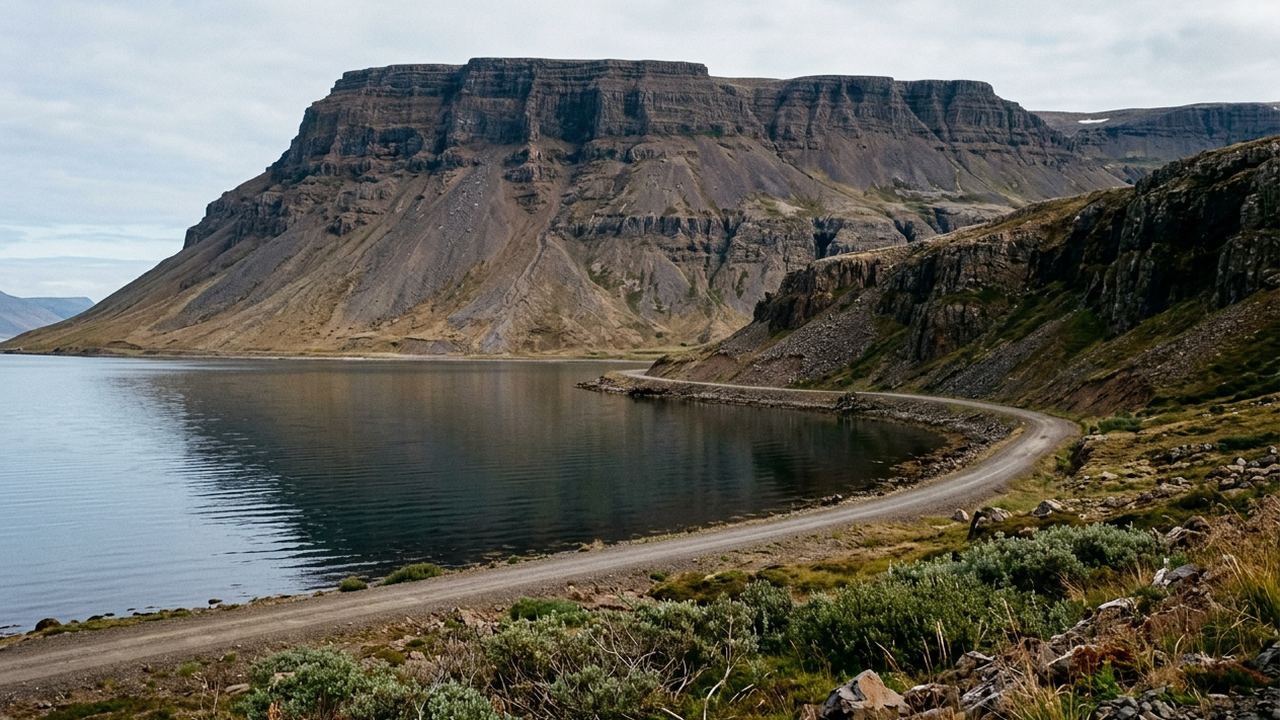
The second thing the pictures leave out is the shape of the driving. Look at a map and the peninsula seems compact, forty miles across at the waist. Drive it and the distances triple, because the road does not cross anything. It runs to the head of each fjord, turns, and comes back down the far side, so twelve miles as the raven flies is thirty eight miles of tarmac and gravel with the sea on your right the whole time. People book four nights here and spend all four of them driving. Nine nights is the number that lets the car stop.
The third thing is that this is not a gentler version of the south coast. It is a genuinely remote piece of ground. There are stretches of eighty miles with one gas pump on them, villages of forty people where the grocery closes at six, and cell coverage that goes away in the passes and comes back at the next inlet. That is the appeal and it is also the whole difficulty, and it is why this week is arranged as one piece rather than sold as a car and a list of towns.
- What the week is
- Nine nights in five guesthouses, two of them for three nights each, moving between them in a small rented four wheel drive that you drive yourselves; luggage stays in the vehicle and comes into each house with you at the end of the day.
- What sets it apart
- Most people who say Iceland mean the ring road and the south coast, which is a different country in practice. The Westfjords hang off the northwest on a peninsula the ring road never touches: roughly five hours from Keflavik airport by road, or a two hour drive plus a ferry, or an internal flight of fifty minutes to Isafjordur. Beds are guesthouse rooms in working villages, wooden floors, thin walls, breakfast at a shared table. The road opens through the passes in late May and the last houses close in the second half of September. From $2,940 per person, two sharing.
- What the figure covers
- Nine nights in five guesthouses, twin or double, all breakfasts; a compact four wheel drive with unlimited mileage, gravel protection and second driver; all fuel; the ferry crossing to and from the peninsula if you take that route rather than driving the long way; the boat out to the bird cliffs on a fixed date; one guided day on foot with a local guide; entry to the two swimming pools that charge; a printed route book with every gas station, grocery store and pass on it marked with distances; the whole arrangement placed and confirmed in writing before you leave home.
- What it leaves to you
- Flights to Iceland, which run $520 to $1,100 round trip from the east coast in season; lunches and dinners, realistically $45 to $80 a head a day because there are few restaurants and the ones that exist are not cheap; the internal flight to Isafjordur if you prefer it to driving, about $190 each way; single occupancy, which adds $760 across the nine nights; anything you drink; the tunnel and road tolls on the western route, about $22 total; and any night you spend south of the peninsula at either end because your flight times did not work, which happens more often than people expect and costs $130 to $210 a room.
- Who this one is wrong for
- Do not book this if anyone in the party cannot sit in a car for four hours with two stops. Three of the nine days involve 90 to 140 miles of driving, most of it single lane gravel with drops on the sea side and no barrier, at 25 to 35 miles an hour. The bird cliff walk is two miles on soft ground with a 400 foot climb and no handrail anywhere near the edge. Two guesthouses have the bedrooms up a steep wooden staircase and no lift exists in any of them. Anyone with vertigo, recent surgery or a real fear of heights should read the failures below and pick something else.
What the ground and the sky actually do to a day here
The road surface changes without warning. Roughly a third of the route on this week is unsealed: compacted gravel, washboard in places, with loose material on the outside of bends. The safe speed is 25 to 35 miles an hour and there is no way to make it faster. A stretch that measures 60 miles takes two hours and ten minutes with no stops at all, and you will stop, because the road climbs over three passes with views that are hard to drive past.
Weather in this corner does something that surprises people who have only read about Icelandic rain. It is not usually heavy. It is horizontal, and it changes four times between breakfast and lunch. In June the daytime high sits around 48 to 54 degrees Fahrenheit, in early September around 43 to 50, and the wind takes ten to fifteen degrees off that on any exposed ground. What ends a day here is almost never cold. It is wind that makes standing upright on a headland genuinely difficult.
The good hours are long, though, and that is the practical gift of the place. From late May to late July there is usable light at midnight, which means a day that starts badly can be rescued at nine in the evening. The route book is written around this. Two of the days have nothing fixed in them at all, on purpose, so a blown out morning can become a good night.
The kind of party that gets the most out of nine nights here
This week suits people who like being somewhere sparse and are content to look at it for a long time without an activity attached. The hot pools are the clearest test. Two of them are concrete tanks by the road fed by a hot spring, no attendant, no changing room worth the name, a slot for coins on the honor system, and on a September afternoon there is a real chance nobody else is in them. If that reads as a highlight, this is your week. If it reads as underwhelming, the Westfjords will disappoint you for nine nights running.
It also suits people who have not done a self driven trip before and do not want to be the one making the calls. The route book exists for exactly that reason. Every day has a distance, a driving time that assumes gravel, the location of the last gas before a long empty stretch, and a written note about what to do if a pass is shut. That is the part first timers get wrong on their own, and it is the part that makes this trip work for someone traveling alone as easily as for two.
Six cells, one for each obstacle, filled where this trip answers. Read the words below rather than the strip; the strip is a shorthand.
- The dates are fixed and short
- answers it. Everything else that answers it
- Somebody will not fly, or not far
- does not. Getting to Iceland from North America is a flight over open ocean of five to seven hours with no rail or sea alternative, so somebody who will not fly cannot reach the start of this week at all. What does
- The party moves at two speeds
- does not. Three days are long drives on gravel and two guesthouses put the beds up a staircase, so a party that splits into a walker and a person who cannot manage stairs will be uncomfortable for most of the week. What does
- Nobody has done this before
- answers it. Everything else that answers it
- The free weeks are out of season
- answers it. Everything else that answers it
When the road opens, when it shuts, and what each part of the year costs you
- Late April to mid May
- Passes are still uncertain and several guesthouses have not opened. Roads can shut for a day at a time. We do not place this week before the third week of May and will say so plainly if you ask.
- Third week of May to mid June
- The road is reliably through, birds are on the cliffs in full number, snow still sits on the table mountain tops. Around $2,940 per person. Some village restaurants have not opened yet.
- Mid June to late July
- Light at midnight, all houses open, warmest weeks at 50 to 57 degrees. Beds are tightest and the figure rises to about $3,380 per person. Book eight to ten weeks out.
- Early to late August
- Puffins leave the cliffs in the first half of the month and the bird boat becomes a different and emptier trip. Berries everywhere. Around $3,180 per person, easier to place at short notice.
- Early to mid September
- The emptiest week of the year, which is a fact about crowds and not about price: around $2,940 per person, roads clear, hot pools genuinely deserted, first darkness returning at night.
- Second half of September
- Guesthouses begin closing on individual dates rather than all at once. We can still place this week but the five houses become four with one longer drive.
- October to April
- The office does not place this trip. The road is not dependably open, most beds are shut, and a week built around driving a coastal route is the wrong thing to sell for those months.
The single road is the whole trip and also the whole risk
Here is the drawback stated properly. There is essentially one route in and around the peninsula, and when a section of it closes for weather or a landslip, there is no parallel road to use instead. The alternative is a detour of 120 to 200 miles, or a day spent waiting. This happens a handful of times each season, more often in May and September than in the middle. If it happens on your week, the office reworks the order of the houses by phone with the guesthouses directly, and you lose a planned day. Nobody can promise otherwise, and any office that tells you the road never shuts has not spent a spring here.
The second awkward thing is money, and it is worth saying flatly rather than in the small print. Eating is expensive and the choice is thin. Outside the two largest villages there may be one place serving food, closing at eight, with eleven items on the menu. Budget $45 to $80 a head a day and buy groceries in the larger towns when you pass them, which the route book marks. The office takes no payment for any of this and holds no card number: the guesthouses and the car company bill you directly, and the office is paid a commission by them after you are home. That arrangement is why the route book tells you where the cheap groceries are instead of steering you toward a restaurant.