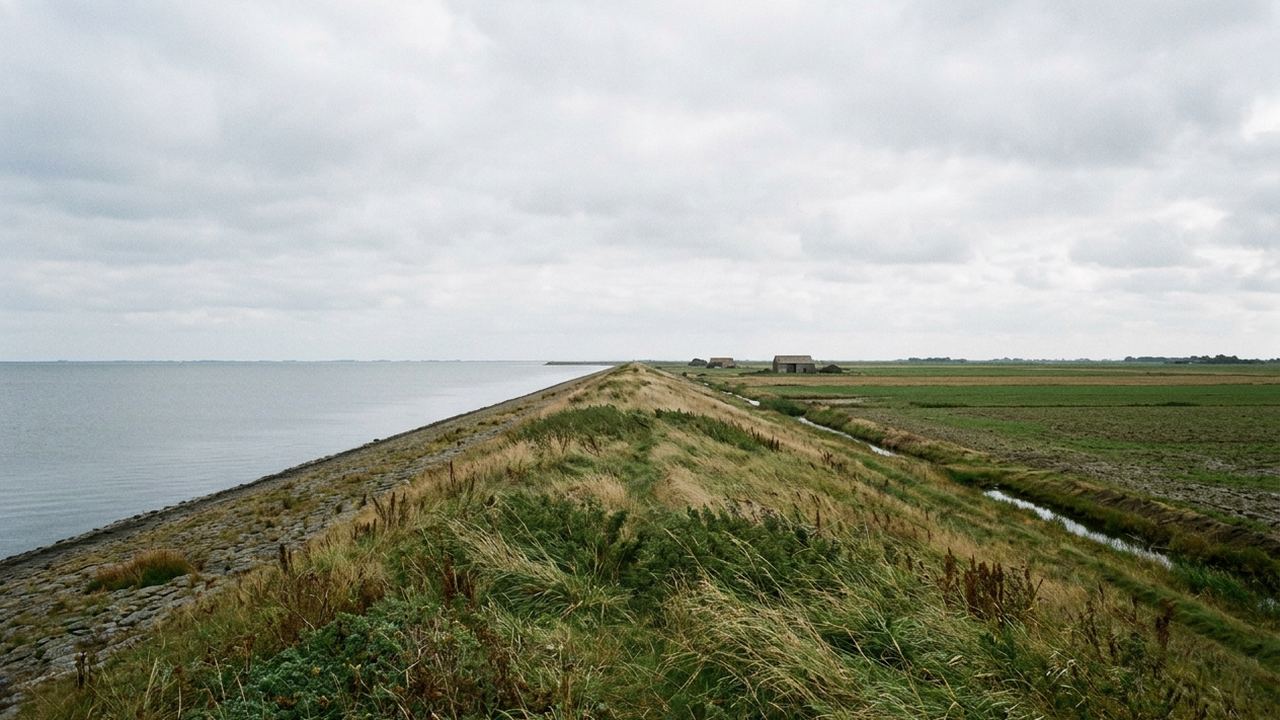
The photographs are always taken in the four hours after a front clears, when the water goes still and the light comes in low and level and every dyke reads as a clean line. Those hours are real. They are also about a fifth of the daylight in a normal week. The rest of the time the sky is moving fast, the water has chop on it, and the wind is somewhere between twelve and twenty five miles an hour, which is what a coast this exposed does for most of the year. People who come back happy are the ones who understood before they arrived that the wind is the weather here, not an interruption of it.
The second thing people get wrong is the shape of the place. Zeeland is not a coastline with towns strung along it. It is a delta: the mouths of three rivers broken into islands, and since the mid twentieth century those islands have been joined by a chain of dams built after the 1953 flood killed more than 1,800 people in one night. Riding across the Oosterscheldekering means riding across a five and a half mile barrier with sixty five concrete piers and gates that still close when a storm surge is forecast. It is a working piece of infrastructure with a bike path on it, not a scenic bridge.
And it is empty in a way that surprises people who booked it as a Netherlands trip. There are no canal houses leaning over water here and no crowds funnelling through a single old center. Middelburg has an abbey and a tower and about 48,000 people. Veere has 1,500. Between them is farmland, orchard, salt marsh and dyke, and on a Tuesday in May you can ride an hour and see four cars.
- What the week is
- Nine nights in four family run hotels, two of them for three nights each, moving between them by bicycle on paved dyke paths of eighteen to thirty two miles a day, with the main bags driven ahead by van each morning.
- What sets it apart
- The obvious alternative is the Loire or the Danube, and both are river routes with a current to follow. Zeeland has no current and no hills at all: the highest point on Schouwen-Duiveland is a dune, and the climbs are the ramps onto the dams. Middelburg is three hours by train from Amsterdam Schiphol with one change at Rotterdam, and two and a half hours from Brussels. Beds are small hotels of eight to twenty rooms in Veere, Zierikzee, Domburg and Goes. The riding season runs late March to early November. Nine nights, from $2,240 per person.
- What the figure covers
- Nine nights in twin or double rooms with private bathroom; breakfast every morning; a seven speed hybrid bicycle with pannier, lock, pump and repair kit for the full nine days; luggage transfer by van between all four hotels; a waterproof route book with paper maps and a loaded GPS file; the reserved crossing on the Vlissingen to Breskens foot and bicycle ferry; two seated dinners, one of them a mussel dinner in Yerseke when the season allows; tourist tax and city levies at all four towns; and a local number that answers during the working day for eight days of riding.
- What it leaves to you
- Flights or rail to and from the Netherlands, which runs about $180 each way from a European hub; seven of the nine evening meals, at roughly $28 to $45 a head with a drink; lunch, at $12 to $20; bicycle rental upgrades, at $95 for an electric bike and $140 for a recumbent for the week; a single room, at $560 for the nine nights; travel insurance of any kind, which this office does not arrange or advise on; museum and church tower entries, at $6 to $14 each; and the $30 refundable deposit some hotels ask for the bicycle key.
- Who this one is wrong for
- Do not book this if nobody in the party can ride eighteen miles on a flat road, because the shortest day is eighteen miles and there is no van to pick you up mid route. The wind is the real demand. A twenty five mile headwind on an exposed dam feels harder than a hill, and it can last five hours without a tree to hide behind. Riders needing a stair free room should say so at request: three of the four hotels have a lift, one does not, and its ground floor rooms are two of eleven.
What the wind actually does to a day
The riding surface is not the variable. Dutch bike infrastructure on these islands is paved, separated from traffic for most of its length, and signposted with numbered junctions you follow like a phone number: ride to 42, then 17, then 63. You do not navigate by map here so much as by numbers on posts, and after two days most people stop looking at the route book.
The variable is direction. The prevailing wind is southwest, off the North Sea, and the standard planning mistake is to design a loop that is beautiful on paper and puts you into that wind for the last two hours of every day, when you are tired. The route as booked runs the long exposed sections in the mornings where the direction allows, and keeps the sheltered inland stretches behind orchard windbreaks for the afternoons. It does not always work. On a day when the wind swings northeast, which happens perhaps one day in six in spring, everything reverses and the sheltered leg becomes the hard one.
Put numbers on it. Eighteen miles with the wind behind you on flat ground is about ninety minutes at an unhurried pace. The same eighteen miles into a twenty mile headwind is two and a half to three hours, and it is three hours of continuous effort with no descent to recover on, because there is nothing to descend. That is the honest range of a day here: two hours or five, and the difference is decided the night before by a weather system over the Atlantic.
The party this week fits, and the party it does not
This suits people who want to be in Europe without a flight inside it. Middelburg is reachable by rail from Amsterdam, Brussels, Antwerp or Rotterdam, and the one water crossing on the route is a scheduled ferry for foot passengers and bicycles across the Westerschelde, twenty minutes, running roughly hourly. Somebody in the party who will not board a plane for a five hour hop can still do this whole week. It also suits people who have never put a trip like this together and do not want to be the one holding the map: the rooms are booked, the bags move themselves, and the day's decision is what time to leave.
It suits October and March travellers particularly well, which is unusual. Because the appeal here is not warmth and not swimming, going outside the crowded weeks costs you very little of what you came for, and the light in late October on this coast is the best light of the year.
Six cells, one for each obstacle, filled where this trip answers. Read the words below rather than the strip; the strip is a shorthand.
- Somebody will not fly, or not far
- answers it. Everything else that answers it
- The party moves at two speeds
- does not. Every person in the party rides the same distance on the same day, so a walker and a non rider cannot be split between the bike and a car. What does
- Nobody has done this before
- answers it. Everything else that answers it
- The free weeks are out of season
- answers it. Everything else that answers it
- One person travelling
- does not. The single room supplement is $560 for nine nights and the bicycle hire is not shared, so a solo booking carries the whole room cost with no offset. What does
Reading the calendar before you pick a week
- Late March to mid April
- Cold and bright or cold and wet, 44 to 54 degrees. Wind is at its most changeable. Some beach pavilions still shuttered, and one of the four hotels opens on April 1. Lowest rates of the year at the base figure.
- Mid April to late May
- The best riding weather most years, 55 to 66 degrees, long light until nine in the evening, orchards in blossom on Zuid-Beveland. Books out earliest. Add roughly $180 per person on the base figure.
- June
- Warm and stable, 64 to 72 degrees, the water still cold enough that swimming is a brief idea. Domburg and the western beaches start to fill on weekends. Add about $220.
- July and August
- Busiest by a wide margin. Dutch and German school holidays overlap, Domburg and Renesse are genuinely crowded, and the cycle paths near the beaches carry family traffic all day. Add about $340, and expect to book five months ahead.
- September
- The emptiness returns after the first week. Water is at its warmest of the year, around 66 degrees, and the mussel season is at full run in Yerseke. Add about $200.
- October
- Light gets long and low and the sky does the thing the photographs promised. 50 to 60 degrees, more rain, fewer people on every path. Base figure or slightly under.
- Early November
- Last two weeks of the season. Cold, 42 to 50 degrees, and short days that cap a comfortable ride at about twenty five miles. Two hotels close mid month. Base figure.
The part that costs more than people expect
The single room supplement is $560 and there is no way around it. Small Dutch hotels of eight to twenty rooms do not hold single rooms as a category, so a solo traveller occupies a double and the hotel prices the room, not the bed. The office says the figure at request rather than at the end, because a solo booking here is not a small addition, it is a quarter again on top of the week and people deserve to see that before they get attached to the idea.
The other expense is the one nobody budgets for: the evenings. Seven of nine dinners are on you, and Zeeland restaurant prices are not low. A mussel dinner in Yerseke in season runs $34 to $48 a head, and an ordinary hotel dinner in Veere or Zierikzee lands around $32 with one drink. Across seven evenings for two people that is $450 to $650 that sits outside the figure on this page. There is a cheaper way to do it, which is to eat the main meal at midday in a village cafe and buy bread, cheese and fruit for the evening from a supermarket in Goes or Middelburg, and plenty of riders do exactly that. The office would rather you knew the arithmetic than discovered it on night three.